


GAKUNDU / KENYA 200g
GAKUNDU / KENYA 200g
Couldn't load pickup availability
Produced in Kenya's Embu region, this coffee offers a clean, concentrated fruit character shaped by the area's ideal climate and carefully managed processing.
Tasting Notes: Red Currant, Rosehip, Red Grape, Floral, and a lingering, subtly caramel-like sweetness.
Coffee: Gakundu
Region: Embu
Country of Origin: Kenya
Process: Washed
Processing Station: Gakundu Factory
Varieties: SL28, SL34, Ruiru 11, Batian
Altitude: 1,650 m
Farmer Members: 1,262
Roasted for filter brewing.
Net Weight: 200 g
Located in Ngandori West, Embu County, Gakundu Factory has the potential to stand alongside Kenya's renowned Nyeri and Kirinyaga coffee-growing regions. At an altitude of 1,650 m, fertile red volcanic soils and shade trees such as macadamia and grevillea create an ideal growing environment.
Alongside traditional SL28 and SL34, the farm grows Ruiru 11 and Batian, varieties known for their resistance to disease and pests. The shade trees encourage slow cherry maturation. The late crop (September–January), which accounts for approximately 60% of annual production, benefits from a long maturation period and develops Kenya's characteristic concentrated fruit character.
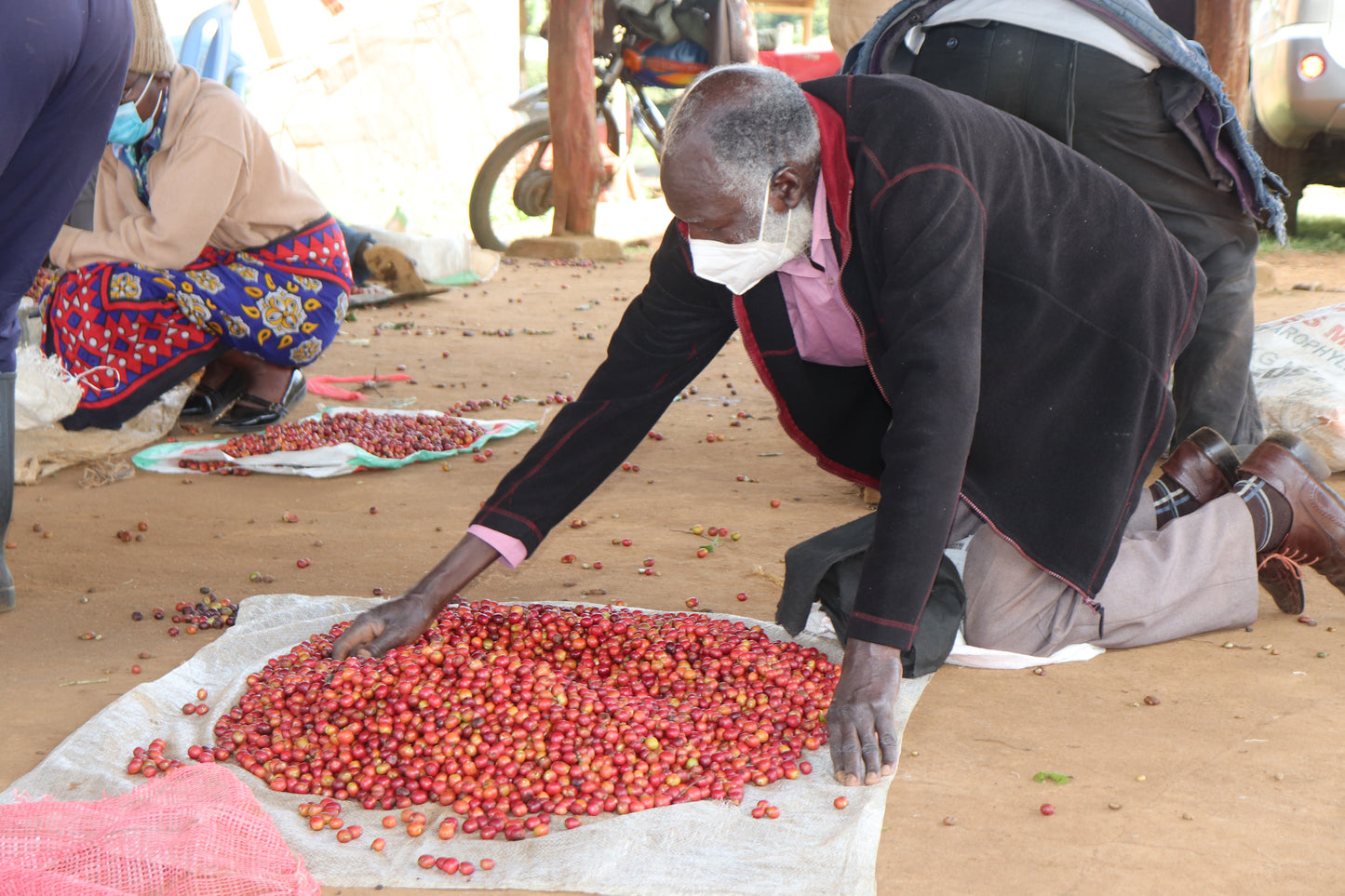
Quality is driven by rigorous selection and precise processing by the Gakundu Farmers' Co-operative Society (FCS). Fully ripe cherries are hand-picked by 1,262 farmer members, sorted again immediately upon arrival, and promptly depulped using an electric disc pulper capable of processing up to 1,000 kg per hour.
After depulping, fermentation is closely managed in response to temperature, water quality, and enzyme levels. Once fermentation is complete, the coffee is thoroughly washed to help prevent defects such as parchment browning. It is then sun-dried on raised African beds until it reaches a safe, optimal moisture content of 10.5%, helping to produce an exceptionally clear and clean cup, free from off-flavours.
Wastewater generated during processing is managed in infiltration pits set apart from water sources to reduce environmental impact. Quality and sustainability are further supported through Good Agricultural Practices (GAP) training in partnership with Coffee Management Services (CMS), together with a pre-financing programme for farmer members.


Please also see
Extraction method
This is the extraction recipe we actually use.
Ratio of coffee beans to hot water
For every 1 part coffee beans, use approximately 16 times the amount of hot water.
Examples:
12g beans, 190g water
15g beans, 240g water
16g beans, 260g water
30g beans, 480~500g water
Equipment to prepare
Ground coffee beans, dripper, paper filter, server, scale to measure hot water, hot water, kettle, timer.
Water temperature
Recommended around 93℃
(When boiling water is transferred to an extraction kettle, it will drop to about 94℃ in 30 seconds to 1 minute.)
Basic Recipe
Recipe for 1 mug (Finished coffee: 220~230g)
Coffee beans: 16g
Hot water to pour: 260g
- Set the paper filter in the dripper.
- Rinse the filter with hot water to wash away paper odors and warm the equipment.
- Drain the water thoroughly and add the coffee beans.
- 0:00 First pour of 40g hot water
- Bloom for 40 seconds.
- 0:40 Pour 60g hot water (total 100g)
- 1:10 Pour 60g hot water (total 160g)
- 1:45 Pour 50g hot water (total 210g)
- 2:20 Pour 50g hot water (total 260g)
- Finished
The target dripping time is around 3:10~3:30.
Success is when you achieve a fruity flavor supported by sweetness and a pleasant, long-lasting aftertaste.
(Depending on the type of beans, the sweetness might be stronger than the fruitiness, or the aftertaste might be short and clean.)
About aging
Coffee Aging - The Luxury of "Waiting" for Deliciousness
Do you think that "fresh coffee must be drunk immediately"?
In fact, coffee has an "optimal drinking period" when it tastes best.
This is called "aging."
Why Aging is Necessary
Freshly roasted beans contain a large amount of trapped carbon dioxide.
If this gas remains, hot water cannot fully extract the components of the beans, resulting in a dull taste.
By "aging" the beans, slowly releasing the gas over several days to weeks, the coffee's inherent sweetness and clear fruitiness emerge, as if a mist has cleared.
Drinking Period Guidelines
KRW's coffee is roasted thoroughly to its core, concentrating its components.
Therefore, it requires a slightly longer rest period than typical coffee.
Recommended from 7 days after roasting
This is the peak time when the aroma becomes most brilliant and the texture (body) becomes smoothly refined.
The flavors continue to integrate as 10 and 15 days pass.
Storage Methods to Maintain Deliciousness
To ensure the aging process proceeds correctly, by following these two points, you can maintain ideal aging.
Seal and Store in a Cool, Dark Place: The enemies of coffee are "oxygen, light, and heat." Store in a bag with a valve or in an airtight container in a cool place away from direct sunlight.
Grind Immediately Before Brewing: Grinding dramatically increases the surface area, causing gas to escape and aging to accelerate rapidly, making long-term storage impossible. Store as whole beans whenever possible and grind just before drinking.
Time is the final piece that completes coffee. Please enjoy the subtle changes in its character over time, starting from the roasting date.